
In today’s healthcare landscape, digital patient records are essential for efficient, secure, and high-quality care. When evaluating software for your practice, you’ll often come across two terms: EHR (Electronic Health Record) and EMR (Electronic Medical Record). While these terms are sometimes used interchangeably, they represent different approaches to managing patient information.
Understanding the distinctions—and knowing which system best fits your practice—can improve patient care, streamline workflows, and support practice growth. For integrative, multidisciplinary, or specialty practices, this choice is particularly critical.
What Is an EMR?
Electronic Medical Records (EMRs) are digital versions of patient charts used within a clinical practice. At their core, EMRs are designed to support day-to-day care delivery by giving providers fast, organized access to patient information.
Modern EMRs do far more than replace paper charts. They serve as the clinical backbone of a practice, enabling accurate documentation, continuity of care, and operational efficiency. EMRs allow providers to document medical histories, track treatments, and manage lab results electronically.
Key Features of EMRs:
- Digital storage of patient charts for easy access
- Recording of diagnoses, treatment plans, and visit notes
- Medication and allergy tracking
- Storage of lab results, imaging, and test reports
- Reporting tools for clinical and operational insights
EMRs help practices stay organized, reduce documentation errors, and significantly improve internal workflows. For many specialty and integrative clinics, a well-designed EMR provides exactly what’s needed: depth of clinical documentation, flexibility, and control over how care is delivered.
While traditional EMRs were once limited to internal use, today’s all-in-one EMRs have expanded well beyond basic record-keeping—offering connectivity, patient engagement tools, and care coordination features that rival EHR systems.
What Is an EHR?
Electronic Health Records (EHRs) build on the EMR foundation by emphasizing data sharing across multiple healthcare organizations. EHRs are designed to support interoperability, allowing patient information to move more easily between practices, hospitals, labs, and pharmacies.
Key Features of EHRs:
- Longitudinal patient health records across care settings
- Integration with external labs, pharmacies, and imaging centers
- Population health and analytics tools
- Support for clinical decision-making
- Patient portals and secure messaging
- Telehealth and remote care capabilities
EHRs are especially valuable in large health systems or environments where patients frequently transition between independent organizations.
EMR vs EHR: Core Differences
Understanding the distinction between EMRs and EHRs can clarify which system best fits your practice needs.
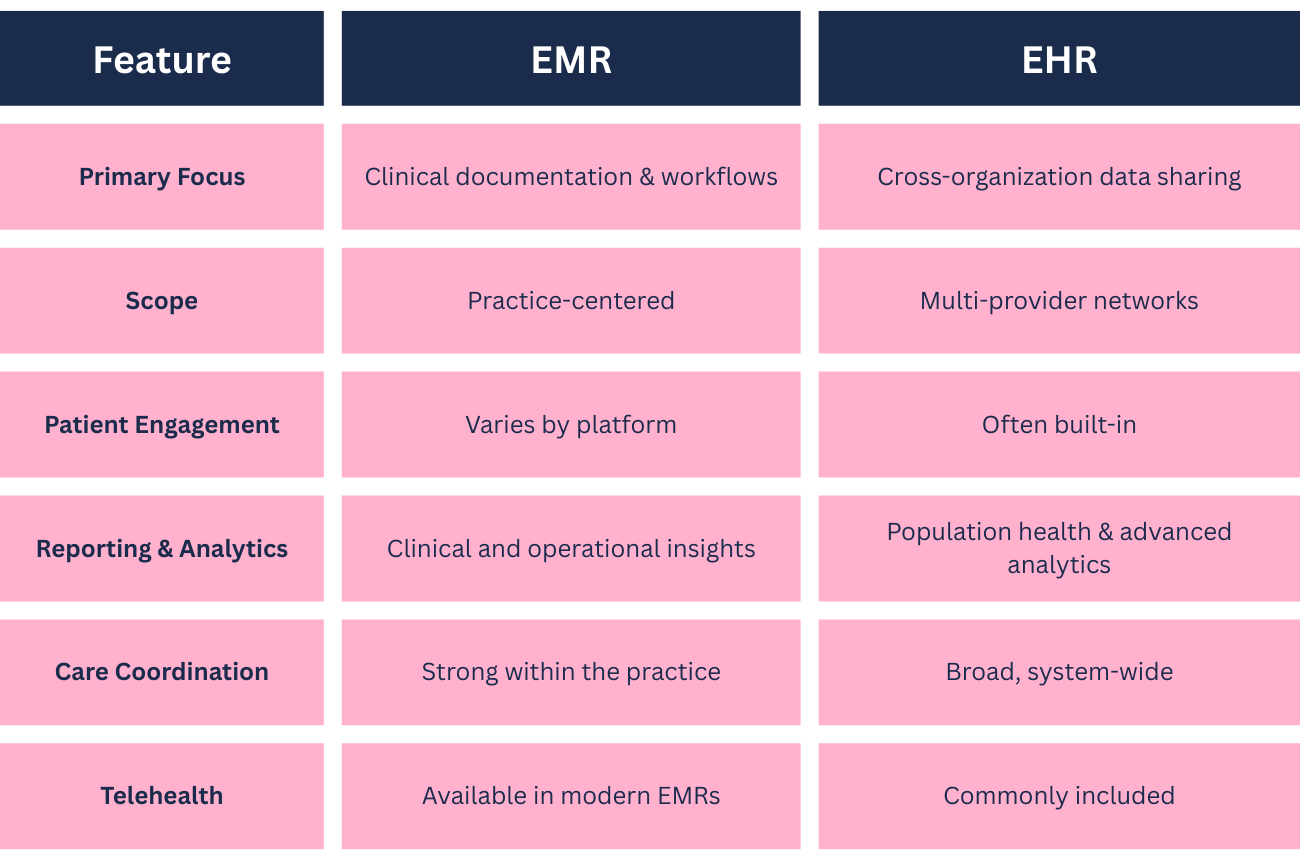
In short, EMRs excel at powering clinical care inside a practice, while EHRs emphasize broader interoperability. Today’s most effective platforms combine these strengths rather than forcing practices to choose one or the other.
EMR or EHR? Which Should Your Practice Choose?
Choosing between an EMR or an EHR depends on your practice’s size, structure, and approach to patient care. While both systems digitize patient information, they are designed to support different operational and clinical needs.
- Single-practice or specialty clinics often thrive with a powerful, modern EMR. These systems are well-suited for practices that prioritize detailed clinical documentation, specialty-specific workflows, and efficient in-house operations. EMRs allow providers to maintain comprehensive patient records, track treatment progress over time, and streamline daily tasks such as charting, scheduling, and billing—all within a single practice environment.
- Large networks or hospital systems typically require a traditional EHR. Because these organizations operate across multiple locations and care settings, EHRs are designed to support extensive data sharing and interoperability. They enable providers across different organizations to access and contribute to patient records, supporting continuity of care at scale and reducing duplication of services.
- Integrative and multidisciplinary practices often fall somewhere in between. These practices benefit from systems that balance robust clinical documentation with tools that support care coordination, patient engagement, and longitudinal record-keeping. The ability to manage complex treatment plans, track outcomes over time, and communicate effectively with patients and care teams is essential in these settings.
Ultimately, the right choice is the system that aligns with how your practice delivers care today while remaining flexible enough to support future growth. Whether through a modern EMR or a fully interoperable EHR, the goal is the same: to improve efficiency, support high-quality care, and create better experiences for both providers and patients.
Why Modern EMRs Matter for Today’s Practices
For many integrative, specialty, and multidisciplinary clinics, success depends on detailed documentation, flexible workflows, and patient-centered care—not just large-scale data exchange.
As EMRs have evolved, many practices now benefit most from an all-in-one EMR—a system that delivers robust clinical documentation while also supporting interoperability, patient engagement, and modern care delivery.
OptiMantra is a comprehensive all-in-one EMR designed specifically for integrative and specialty practices, providing a centralized platform for clinical documentation, practice management, patient engagement, and coordinated care.
Key Benefits of OptiMantra’s All-in-One EMR:
- Complete Digital Patient Records: OptiMantra allows providers to store and access detailed patient information, including medical histories, medications, lab results, and treatment plans—all in one place.
- Seamless Care Coordination: The platform enables secure sharing of patient data with other providers, specialists, and labs, ensuring collaborative, coordinated care.
- Patient Portal and Engagement: Patients can access their health information, review visit notes, schedule appointments, and communicate with providers securely.
- Telehealth Integration: OptiMantra supports virtual visits, enabling flexible care options and reducing no-shows or missed appointments.
- Customizable Workflows: The platform is designed to match the needs of specialty practices, with templates and tools tailored for integrative care.
- Advanced Reporting and Analytics: Clinics can monitor outcomes, track patient progress, and make data-driven decisions to improve efficiency and care quality.
By offering an all-in-one solution, OptiMantra removes the need to juggle multiple platforms, reduces administrative overhead, and ensures that all aspects of patient care are centralized and accessible.
A Smarter Way Forward
The difference between EMRs and EHRs isn’t about which is “better,” but about which approach best supports your care model. EMRs provide the clinical foundation that practices rely on every day, while EHR features extend that foundation outward.
With an all-in-one EMR like OptiMantra, practices don’t have to choose. You get:
- Efficient, accurate digital records
- Seamless care coordination
- Patient engagement tools and telehealth integration
- Advanced analytics and customizable workflows
OptiMantra is more than an EMR—it’s a complete solution for modern practices that want to streamline operations, enhance patient care, and grow their practice.
Take the Next Step
Discover how OptiMantra’s all-in-one EMR can transform your practice, streamline workflows, and enhance patient care with a demo or free trial today! Invest in a platform that supports your vision for integrative and specialty care.



.png)